Hybrid Zones and Plant-Animal Interactions

.... the cutting edge for evolutionary studies where recombinant genotypes are continually being formed and tested


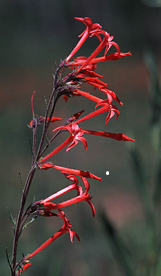
Scarlet Gilia

red varient dark pink varient pink varient white varient


We have previously shown how individuals and populations of scarlet gilia track changing pollinators through seasonal shifts in flower color.


We are currently interested in the effects of hybridization in scarlet gilia on plant-herbivore interactions. We have had the rare opportunity of watching Heliothis phloxiphagus move from low elevation populations of pure red Ipomopsis aggregata into one of our high elevation hybrid populations of scarlet gilia, which ranges in flower color from red, through several shades of pink to completely white.


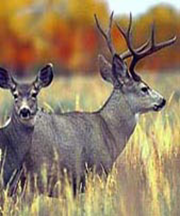
We have recently assessed the effects of the independent and interactive effects of both deer and elk browsing and caterpillar feeding on each of the color variants. Results show that ungulate herbivores alone had a net positive effect on plant relative fitness, increasing seed production approximately 2-fold. Caterpillars had no effect on plant relative fitness when acting alone, with caterpillar-attacked plants producing the same number of flowers, fruits and seeds of uneaten controls. Caterpillars, however, significantly reduced the flower production of ungulate browsed plants. Flower production of these plants, however, was still significantly greater (approximately 1.7 fold greater) than uneaten controls, likely leading to an increase in reproductive success through the paternal component of fitness given that fruit and seed production was not significantly different from that of herbivore-free controls.caterpillar


Plant hybridization had no significant effect on patters of ungulate of caterpillar herbivory; i.e. no significant interactions were detected between herbivory and plant hybridization for any of the fitness traits measured in this study or did plant hybridization have any significant effect of host preference. These results may be due to patterns of introgression or the lack of species-specific differences between I. aggregata formosissima and I tenuituba.


We are also interested in determining whether "hybrid" populations of scarlet gilia are due to hybridization events between two species, red Ipomopsis aggregata and white Ipomopsis tenuituba, or due an in situ event where a mutant white formed what appears to be a hybrid swarm. To differentiate between these two hypotheses we are planning on using microsatellite markers to compare individuals from pure red, pure white and hybrid populations.  


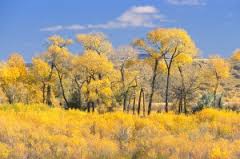
Cottonwoods

Some of our past projects on cottonwood hybrids have included:


Parental and Hybrid Leaves 1. The genetic characterization of a cottonwood, Populus fremontii and P. angustifolia, hybrid zone using nuclear and mitochondrial RFLP markers.
Aphid gall 2. How host-plant genotype and hybridization in cottonwood affects the attack and survival of the gall-forming aphid, Pemphigus betae.
hybrid zone
pacman hypothesis
3. The ecological and evolutionary dynamics of this cottonwood hybrid zone. Results of our genetic studies have shown that hybridization is unidirectional; i.e., hybrids only backcross with pure narrowleaf and no hybrid by hybrid or hybrid by Fremont crosses occur. A hybridization pattern of decreasingly complex backcrosses as one proceeds from higher to lower elevation within the hybrid swarm, a residue of Fremont cytoplasmic DNA within the pure narrowleaf population and the unidirectional nature of these crosses suggest that the narrowleaf population may be spreading down the canyon and the Fremont population receding due to the continual purging of the Fremont genome (i.e., the pac-man hypothesis).