|
|
| Home Group Sites Subject Sites Individual Sites Educational Sites Other | ||
|
Subject Sites Sites for Educators/Students Other
|
Photosynthesis Web Resources
Individual Researcher’s Sites In this section we list a number of individual sites that we feel are well done. Most scientists have sites set up by their academic department but those often contain little more than contact information, very brief politically correct information on research and perhaps a CV and a list of publications. We favor sites that are created and maintained by the individuals themselves, not their departments, and which contain detailed research descriptions (not just brief summaries), useful figures, links to other sites, and personal information that help us see the researcher as a person. It is our opinion that a multi-layered site reveals the richness of the researcher’s personality and lab group. We feel that potential students might be attracted to those that take the time to set up a rich site over simple cookie-cutter sites. Many of the sites we have selected may seem a bit simple when first viewed, but their richness is revealed when links (sometimes very subtle due to the playful nature of scientists) are followed. Many more Web sites will be found in the “Nicelist” Web site maintained by one of us (LO) (http://bioenergy.asu.edu/photosyn/nicelist.html). All sites are listed alphabetically by the researcher’s last name. We apologize in advance to those we may have missed and will add new links to the online version as we discover them. Feel free to let us know of any amazing sites you create or run across. John F. Allen (http://queenmaryphotosynthesis.org/~john/index.html) contains much useful information. His older site (http://jfa.bio.qmul.ac.uk/~john/webstar/john/index.html). A deceptively simple site that contains quiet links to many areas of photosynthesis, as well as interesting private places. There are tours; there is animation; and there is music. John Allen was one of the very first photosynthesis researchers to have his own Web site. James Barber (http://www.bio.ic.ac.uk/research/barber/index.htm). This site contains well-illustrated pages involving his research on Photosystem II, Photosystem I and other areas. Carl Bauer (http://www.bio.indiana.edu/~bauerlab/). Pages found here cover photosystem gene expression, evolution of photosynthesis and more. Robert E. Blankenship (http://biology4.wustl.edu/faculty/blankenship/). Interesting lab site with pages describing work on Photosystem I, chlorosomes, the Fenna-Mathews-Olson (FMO) protein, evolution of photosynthesis and much more. Includes photos (http://pages.wustl.edu/blankenshiplab/photo-gallery/alvin-trip) from a dive in the Alvin submersible during which photosynthetic organisms were found living in the depths around volcanic vents! (http://www.asu.edu/feature/includes/summer05/readmore/photosyn.html) Donald Bryant (http://www.bmb.psu.edu/faculty/bryant/bryant.html) discusses research on structure and function and biogenesis of the photosynthetic apparatus of cyanobacteria and green sulfur bacteria, control of gene expression, and physiology. Most of the details and figures are found by clicking on the link to his lab Web page. John M. Cheeseman (http://www.life.illinois.edu/cheeseman/main/). You know that a site that begins with, “Purveyors of Versimilitude and Synthesizers of the Obvious since 1975,” will be fun! Contains links to his research on mangroves, courses on: Form and function in higher plants, introduction to plant biology and field ecology. A software program (that you can download) for a multimedia textbook on photosynthesis (by Cheeseman and M. Lexa) is also available at (http://www.life.illinois.edu/cheeseman/photosynthesis/main.html). And don’t forget to check out the links to the “Erratic Crab” where you will learn things like “How much data would a data manager manage if a data manager could get your data?” (http://www.life.illinois.edu/cheeseman/ecrab/ECv1n2/)
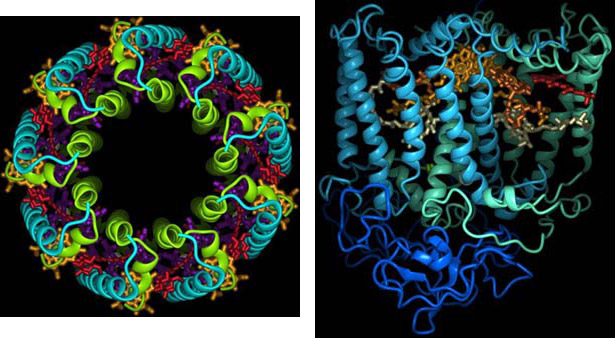
Fig. 11. Structure of Light Harvesting Complex 2, LH2 (left) from Rps. acidophila strain 10050 and the reaction center (right) from Rhodobacter sphaeroides from Richard Cogdell’s Web site (http://www.gla.ac.uk/researchinstitutes/biology/staff/richardcogdell/). Richard J. Cogdell (http://www.gla.ac.uk/researchinstitutes/biology/staff/richardcogdell/) Follow the links to a very rich Web site with incredible images of light-harvesting complex II and the reaction centers (Fig. 11). William Cramer (http://www.bio.purdue.edu/lab/cramer/) . Contains good descriptions and figures of work with the structure of cytochrome b6f complex, cytochrome f and the Rieske iron-sulfur protein. Antony Crofts (http://www.life.illinois.edu/crofts/). This site is a virtual goldmine of information. There is much here on the cytochrome bc1 complex and many other subjects, including many helpful links. It contains a good cartoon animation of the Rieske Iron sulfur protein. Charles Dismukes (http://dismukeslab.99k.org/). A good site that contains many links to research on photosynthetic water splitting enzyme; manganese catalase; manganese cubane; and paleobiochemistry; it has good figures and discussions. Graham Fleming (http://www.cchem.berkeley.edu/grfgrp/) contains information on the use of femtosecond spectroscopy to study light-harvesting photosynthetic compounds and many fun photos. The group photo and photos of past and present lab members are always intriguing. Also check out his lab’s work on quantum mechanical effects in photosynthesis (http://www.lbl.gov/Science-Articles/Archive/PBD-quantum-secrets.html) that adds new ideas and concepts of coherence to the existing energy transfer models.
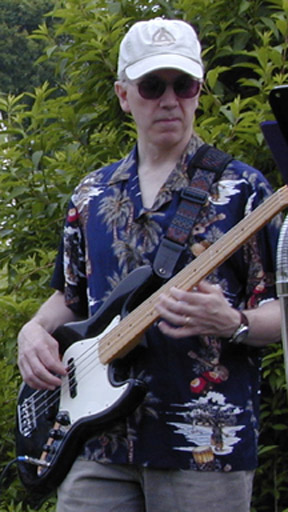
Fig. 12. Harry Frank: photosynthetic musician, author of “melted carrot,” http://frankgroup.uconn.edu/frank_podcast.html. Harry Frank (http://frankgroup.uconn.edu/). This site contains several brief descriptions of work on the structure and function of carotenoids; role of xanthophylls in non-photochemical quenching of chlorophyll fluorescence; electrochemistry of cofactors of photosynthetic reaction centers. There are many fun things here and even a link to the Harry Frank podcast with the good professor on electric guitar [Fig. 12!] playing his song “melted carrot” as well as great discussion of carotenoids (http://frankgroup.uconn.edu/frank_podcast.html), and lots more. This is one of our favorite sites for its scientific as well as personal presentations. You can also check out his Facebook page at http://www.facebook.com/profile.php?id=1132602120&v=info&ref=name. Petra Fromme (http://www.public.asu.edu/~pfromme/index.html) uses crystallography to study the biophysical chemistry of membrane proteins. Much of her work can be found in links to PDF files. Govindjee (http://www.life.illinois.edu/govindjee/). This site contains many links to all parts of the photosynthesis universe. There is a nice “Photosynthesis Education” site at http://www.life.illinois.edu/govindjee/PSed_index.htm). Research publications in the areas of primary photochemistry; role of bicarbonate in Photosystem II; chlorophyll a fluorescence, among other topics can be found arranged chronologically, as well as according to journals and to topics. A fun place is where photos of students receiving awards are shown. See, e.g., <http://www.life.illinois.edu/govindjee/photooftheyear2012.html>. A useful basic educational material is his 1969 book on Photosynthesis, with E. Rabinowitch (http://www.life.illinois.edu/govindjee/photosynBook.html). [Also see (http://www.life.illinois.edu/govindjee/g/Books.html) for other books.] In August, 2007, he was presented 2nd International Society of Photosynthesis Research’s Communication Award for his outstanding efforts in communicating basic and advanced information on all aspects of photosynthesis, including history of photosynthesis research, through his lectures, reviews, many edited volumes and his series (Advances in Photosynthesis and Research). There are photographs of scientists and complete information on several volumes of the Advances in Photosynthesis and Respiration. A 34 minute interview of Govindjee for the Annual Reviews Inc. can be found at http://www.YouTube.com/watch?v=cOzuL0vxEi0 Harry B. Gray is a chemist at Caltech studying how we can use solar energy to power our world. “Harry Gray: Powering the Planet with Solar Fuel” (http://www.YouTube.com/watch?v=fwqVsRLHq24) is a YouTube video of Harry B. Grays’s hour-long presentation on solar fuel. We are pleased that Northwestern University preserved this interesting lecture. Another YouTube video featuring Harry Gray, “Passion for Science” (http://www.YouTube.com/watch?v=rpJPLptlGVU) discusses how his interest in pigments led to his solar energy studies. EarthSky’s site (http://earthsky.org/energy/harry-grays-solar-fuel-cells-will-create-fuel-from-sunlight) features a link to an 8-minute interview that discusses solar energy and artificial photosynthesis. Roger Hangarter (http://www.bio.indiana.edu/~hangarterlab/). This site discusses environmental sensory response systems and plant development. It has Plants-in-Motion time-lapse movies; has information on Arabidopsis and links to Arabidopsis data bases; and has laboratory exercises for teaching plant growth and motion from elementary schools through college. Although not directly related to photosynthesis, it is a fun site. See for yourself. [Hint: check out the really weird Conehead saga at the Prymaat Files (http://www.bio.indiana.edu/~hangarterlab/otherstuff/prymatfiles/prymatmain.html)] Kazuhito Hashimoto (http://www.light.t.u-tokyo.ac.jp/english/index.htm) contains information on artificial photosynthesis, photocatalysis and environmental issues featuring solar technologies. Alfred R. Holzwarth (http://www.mpibac.mpg.de/webEdition/we_cmd.php?we_cmd[0]=show&we_cmd[1]=2030&we_cmd[4]=260). Contains information on artificial photosynthesis, Photosystems I & II, antenna systems and more. Anne Jones (http://bioenergy.asu.edu/faculty/jones/research.html) studies redox enzymes and how these catalysts work, offering exciting possibilities in such diverse fields as renewable energy generation, biological synthesis, and homogeneous catalysis. Her work on artificial hydrogenases is key to developing some artificial photosynthesis systems. Stephen Long (http://www.life.illinois.edu/long/index.html). This site contains much information on alternative fuels and crops (http://www.life.illinois.edu/long/Media.html) and links to other projects such as SoyFACE (http://soyface.illinois.edu/index.htm) and WIMOVAC (http://www.life.illinois.edu/plantbio/wimovac/), projects studying environmental factors that might influence climate change. Jörg Matysik (http://www.cidnp.net) studies the nuclear polarization occurring during the photosynthetic primary reaction with optical NMR methods. Photo-CIDNP MAS NMR is used to map electronic structures of donors at atomic resolution. Anastasio Melis (http://pmb.berkeley.edu/profile/amelis) studies green algae for photosynthetic production of hydrogen and hydrocarbon biofuels. Sabeeha Merchant (http://www.chem.ucla.edu/dept/Faculty/merchant/index.html). This is a wonderful site on ‘Biochemistry of Molecular Genetics and Metal Metabolism’; it has publication lists since her PhD days, but more importantly many of her papers on cytochromes and plastocyanin and a major review are available in PDF files. We find her ‘Useful Links’ very useful indeed. They include research resources; companies; composition (with links to the famous “The Elements of Style” by William Strunk on line, loved by us); dictionaries; on-line journals; and genome databases. There are also many, many photos of students, colleagues and meetings. Kenneth R. Miller (http://www.millerandlevine.com/km/index.html) from Brown University. Structure and function in biological membranes is the theme of research at this site. There is an interesting essay on “Life’s Grand Design” (http://www.millerandlevine.com/km/evol/lgd/index.html); and a link to an interesting article in Discover on the perils and pitfalls of life with a Y chromosome (http://discovermagazine.com/1995/feb/whitherthey470) that both of the editors needed to read! The site also contains information on beautiful biology text books by Miller and Joseph Levine. He has also become a well-known media supporter of evolution and critic of intelligent design and there is even a link to his appearance on the television show, the Colbert Report! (http://www.colbertnation.com/the-colbert-report-videos/173859/june-16-2008/kenneth-miller). “The collapse of intelligent design, will the next monkey trial be in Ohio?” is Miller’s 2-hour lecture (that begins, interestingly, with a prayer) in which he rips apart Intelligent Design. (http://www.YouTube.com/watch?v=JVRsWAjvQSg&feature=related). Thomas A. Moore (http://bioenergy.asu.edu/faculty/tmoore/) is the director of the Arizona State University Center for Bioenergy & Photosynthesis. Besides the usual description of his research interests, it includes information about climate change and essays about the importance of taking immediate action. There are also side trips to more personal areas such as Jazz and Blues music, especially Texas Blues.
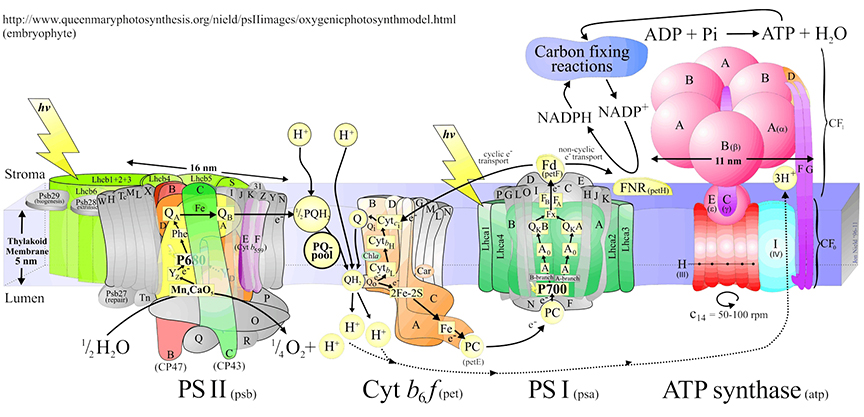
Fig. 13. The major protein structures from Jon Nield’s site : http://macromol.sbcs.qmul.ac.uk/resources/AllComplexes_25Nov2011_1800px.gif. Jon Nield at Queen Mary, University of London (http://macromol.sbcs.qmul.ac.uk/) has an incredibly rich site that covers the major protein complexes involved in photosynthesis. There are numerous discussions and incredible figures available for download from the gallery. Even more downloads and information is available at http://macromol.sbcs.qmul.ac.uk/downloads/downloads.html. See Fig. 13. Daniel Nocera at MIT (http://web.mit.edu/chemistry/dgn/www/) is concerned with a number of research projects including “Solar Energy Conversion” (http://web.mit.edu/chemistry/dgn/www/research/solar.shtml) and “Proton-Coupled Electron Transfer” (http://web.mit.edu/chemistry/dgn/www/research/pcet.shtml). Wikipedia also has an article about Nocera (http://en.wikipedia.org/wiki/Daniel_G._Nocera) and he was picked as one of the Time 100 in 2009 (http://www.time.com/time/specials/packages/article/0,28804,1894410_1893209_1893470,00.html). YouTube video “The Artificial Leaf” (http://www.YouTube.com/watch?v=c-s_c6HjDwM) Daniel Nocera discusses the possibilities. (3:46 min.) Donald Ort (http://www.life.illinois.edu/ort/index.html). The site describes the strategies used by his laboratory on “Molecular biochemical basis for environmental effects on photosynthesis and photosynthetic energy transduction.” There is information on the possibilities of growing crops under future conditions of global change and links to his work at the USDA/ARS Photosynthesis Research Unit. Greg Scholes (http://www.chem.utoronto.ca/staff/SCHOLES/scholes_home.html). The Scholes Group Research site covers quantum mechanics in photosynthesis energy transfer and nanoscale systems. It contains summaries of their work and links to journals and popular magazines that have featured their work. The lab’s personnel section contains some cute personalized cartoons of the members. Steve Theg (http://www-plb.ucdavis.edu/labs/theg/). The theme is transport of proteins across biological membranes and their assembly into larger multimeric complexes. Recent publications are listed in an elegant manner along with the photos of the cover pages of the journal; some are available as PDF files. An interesting text by Steve Theg is: “Are you a cell biologist, a biochemist or a geneticist?” (http://www-plb.ucdavis.edu/labs/theg/cartoon.htm). The site provides links to on-line journals; resources; data bases; software; and dictionary. Elaine Tobin (http://www.mcdb.ucla.edu/Faculty/TOBIN/tobin.html). The theme here is phytochrome-regulated developmental processes, particularly of circadian clock in Arabidopsis. On the emotional side, you can see Philip Thornber’s Memorial bench and its description by Alan Paulson (http://www.mcdb.ucla.edu/Research/Tobin/bench.html Wim F. J. Vermaas (http://bioenergy.asu.edu/faculty/vermaas). The theme is the molecular genetics of photosynthetic proteins. Wim studies structure, function and assembly of photosynthetic proteins by genetic engineering. Recent publication list up to 1999 is available. Also, you can read “An Introduction to Photosynthesis and its Application,” published in World & I (http://bioenergy.asu.edu/photosyn/education/photointro.html). A YouTube video featuring Wim Vermaas discussing biofuels is available: http://www.YouTube.com/watch?v=WYAM0CIwUGI Elizabeth Vierling (https://sites.biochem.umass.edu/vierlinglab/ ). The theme is “heat-shock proteins”; as molecular chaperones; during seed development; in Arabidopsis; and in Synechocystis. A list of publications organized by subject is also available. David Alan Walker passed away recently after producing some very interesting books and other items related to photosynthesis filled with humor and good illustrations (http://www.dawalker.staff.shef.ac.uk/daw/home/index.htm). His books appear in the section on “Books” later on in this review. In August, 2004, he was presented the 1st Communication Award of the International Society of Photosynthesis Research for his outstanding efforts to help communicate information about photosynthesis to the general public. He is very much missed by all of us. Michael R. Wasielewski (http://chemgroups.northwestern.edu/wasielewski). There is good information and links here for photo-induced electron transfer, artificial photosynthesis, and molecular electronics, among others. Charles F. Yocum (http://labs.mcdb.lsa.umich.edu/labs/cyocum/ The theme is biochemistry of Photosystem II and oxygen evolution. The site has a complete lecture (with figures) entitled “Light, Life and Photosynthesis: How Plants make Oxygen.” You will find it at (http://labs.mcdb.lsa.umich.edu/labs/cyocum/files/lecture/CPROFLECT1.htm).
|
Author Contact Information : Larry Orr Govindjee This Website is based on the Educational Review: Photosynthesis Web Resources. Photosynthesis Research (2013) 115: 179–214, DOI: 10.1007/s11120-013-9840-3 Please contact the authors with any broken links, corrections or suggestions |
| 30-Apr-2014 |