|

| |
Some notes on statistical analysis at FACTS-1 regarding RBAI
(relative basal area increment), biomass increment, NPP and
litterfall
David J. Moore, BSc.
Program in Ecology and Evolutionary Biology
University of Illinois at Urbana-Champaign
Moore et al.
"Inter-annual variation in the response of tree growth and productivity of a
Pinus taeda forest exposed to elevated CO2"
submitted to Global Change Biology in 2004. |
| |
Abstract
Rising CO2 is predicted to
increase forest productivity, though the duration of the response and how it
might change with fluctuations in rainfall and temperature is not clear. We
used repeated measures of diameter growth and allometric scaling to estimate
the effect of Free Air Carbon-dioxide Enrichment (FACE) on tree growth and
net primary production (NPP) in a rapidly growing Pinus taeda
plantation over 6 years. Elevated CO2 increased the
relative basal area increment (RBAI) of individual trees and NPP
by between 5.7 % and 19.5 %. The growth stimulation was observed only in
trees in the two intermediate size classes. Neither the smallest, suppressed
trees nor the largest, emergent trees responded to elevated CO2
by increasing RBAI. NPP in both ambient and elevated plots
was positively correlated with rainfall during the growing season. Unlike
the relationship to precipitation, NPP was greatest in years of
intermediate temperature, and the relative increases in RBAI and
NPP in elevated CO2 were positively correlated
with growing season degree day totals. An increase in the proportional
response to elevated CO2 with increasing temperature
is consistent with the predicted photosynthetic response of C3
plants. Exposure to elevated CO2 caused an average
increase of NPP by 182 ± 28 g DM m-2
y-1 and biomass increment was increased by
100 ± 29 g DM m-2 y-1.
Because the growth rates of the largest trees in the forest did not respond
to elevated CO2, its effect on productivity may
diminish in future. Consequently, it is unlikely that increases in forest
productivity globally will adequately offset increasing anthropogenic
emissions of CO2. |
| |
The purpose of this document
The FACTS-1 experiment has provided
one of the richest data-sets regarding the responses of forests to elevated
CO2. One of the main goals of this experiment is to
determine if forests will take up more carbon from the atmosphere as CO2
continues to rise. There are multiple sources of variation in forest
ecosystems for example heterogeneous soil type and soil moisture, variation
in tree density, differences in aspect and elevation. Because many of these
factors can alter the growth rates of trees it is very important to explain
as much variation as possible before we interpret the effects of elevated CO2.
A common way to account for inherent
variation within a field site is to divide experimental plots into blocks
which are areas of the field site which are as closely matched as
possible. The blocking scheme at FACTS-1 has not been completely
satisfactory and in our analysis we have found reliance on statistical
blocking to be inadequate.
In this document I explain how we
dealt with plot to plot differences at FACTS-1 and to underscore the need to
account for these differences. The results from this analysis may be found
in Moore et al. "Inter-annual variation in the response of tree
growth and productivity of a Pinus taeda forest exposed to elevated
CO2" submitted to Global Change
Biology in 2004. Also I have included a draft of the materials and
methods from that publication at the end of this document.
To determine if elevated CO2
increases net primary production in Pinus taeda we need to estimate
the amount of biomass the pines produce in each year.
To calculate Biomass increment we need
to do one of two things:
- measure all the
trees each year and scale dbh to biomass using allometric equations
- measure a
sub-sample of the trees each year, apply a growth rate calculated from
this sub-sample to a one time measure of the dbh of all trees in the
experiment, then scale from dbh to biomass using allometric equations.
We opt for number 2
because we have a long term record of the growth of about 30% of the trees
in the experiment. This is a large sample size and a wide range of tree
sizes were selected at the start of the experiment.
To get good
estimates of NPP we need accurate and precise measurement of the
trees and accurate estimates of the growth rates this requires some
thought.
As some have pointed
out there is considerable variation between the plots in terms of growth
rate, productivity and N content. This was highlighted by Schäfer et al.
2003 (Fig. 1 reproduced from Schäfer et al. 2003). |
| |
|
 |
Fig. 1. (a)
Net primary productivity (NPP) for the first 5 years of CO2
fumigation in the Duke FACE experiment since commencement in 1996. Data from
1996 and 1997 are taken from
DeLucia et al. (1999)
and in 1998 from
Hamilton et al. (2002)
scaled to the plots in this study (see Discussion).
CO2e denotes elevated
and
CO2a denotes ambient
CO2 conditions.
(b) Enhancement ratio of NPP under
CO2e relative to that
under
CO2a since
commencement of
fumigation in 1996. The temporal and spatial variation in the response to
CO2e
within each plot pair is shown for 1999 and 2000 (grey symbols, different
symbol types represent different plots).
(Reproduced
Fig.8 from Schäfer et al.
2003). |
| |
| We need to account for
the causes of this variation. Blocking will only bring us so far because
rings 3,4,5 and 6 are quite variable. Looking at total basal area before
the treatment started 1,2 – 3,4 – 5,6 would have been the pairs which are
most similar to each other in growth rate and starting conditions (Fig.2). |
| |
Going beyond blocking
Early estimates of the treatment effect in this forest
may have been too high because the relative basal area increment declines as
the number and size of neighboring trees increases (Fig.2).
So we must account for this variation in any analysis
carried out. |
| |
|
 |
Fig. 2.The
mean RBAI (over 6 years) for each plot is negatively related to the
sum the basal area of all trees in that plot at the start of the experiment.
Colors refer to each BLOCK. |
| |
| The simplest way to account for this
variation is it to include the Initial Basal Area total as a covariate in a
statistical model. |
| |
Our statistical model
To analyze the
RBAI data for the effect of elevated CO2 while accounting
for the initial difference between plots we use the following model
RBAI
=
year
initialBAtotal
initialBAtotal*year
sizeclass
sizeclass*year
treatment
year*treatment
sizeclass*treatment
year*treatment*sizeclass
And we include the following random factors
block block*treatment block*sizeclass block*sizeclass*treatment
This configuration
essentially tells the model that N=3 blocks, and that trees within each
block are split or grouped into four size classes.
(We can change these random factors a little i.e. we
don’t need to include the sizeclass interaction with block in the model but
it accounts for some variation so I left it in. It changes the p values
slightly but doesn’t change the outcome)
The most important thing here is that we are using the
covariate to remove some of the variation we can’t account for by blocking.
Taking the covariate into account dampens the treatment effect. |
| |
Why did previous studies
overestimate the treatment effect?
If you look at Fig. 2 and compare rings 1 and 2 you
see that the treatment effect is small whereas if you compare rings 4 and 6
the treatment effect is large. However much of the difference between rings
4 and 6 can be attributed to variation in starting total basal area (the x
axis). This is why failure to account for this source of variation causes
overestimation of the treatment effect.
Here’s an example….
This is the output from the model for RBAI of
trees in each plot in 1998. |
| |
|

|
Fig. 3.
RBAI for each plot
estimated for 1998. |
| |
| The average RBAI for elevated is
0.071 (the average of 0.08, 0.065 and 0.068) and the average RBAI for
ambient is 0.06 (average of 0.07, 0.055, 0.055). This would make the
treatment effect 0.071 – 0.06 = 0.011. But much
of the variation is caused by the initial basal area of the plot rather that
the treatment so we take this into account by adding “total basal area” as a
covariate. First we test to see if the slope of the relationship between
RBAI and total basal area differs
significantly between ambient and elevated CO2
and, having excluding this possibility, we assume that the
slopes are the same. Thus we have two parallel lines relating RBAI
to
total basal area in both treatments (Fig. 4). The
treatment effect is the vertical distance between these two lines or the
difference in the ‘y’ intercept. |
| |
|
 |
Fig. 4. Using the covariate to
calculate the treatment effect in 1998. |
| |
| In our example year we see that the
difference between ambient and elevated becomes smaller (Fig. 4). The
estimate for the treatment effect is only 0.008 (+13%) not 0.011 (+18%). |
| |
| Calculating standing
biomass and why we should avoid plot based scaling methods
To estimate the basal area of the trees in each plot we
use RBAI values to ‘grow’ the trees in each plot. We measure the
trees at one point in time (1998) and then apply the growth rates to each
tree. We use allometric regression to convert dbh to biomass for each tree
and sum the total biomass of each plot.
Since RBAI is artificially inflated because of
variation between the plots then using a different RBAI for each plot
causes the biomass increments to be inflated in turn.
If we could remove the effect of CO2
stimulation how would the trees grow? We can try to do this by going back
to the previous example…. |
| |
|
 |
Fig. 5. The output of the stats model
for RBAI of trees in 1998. Each line
represents a prediction of how RBAI changes with total basal area of the
plot. |
| |
| Using the linear relationship between
RBAI and initial total basal area in the statistical model (from Fig. 4)
we can predict the RBAI for any total basal area in either treatment
(Fig.5). Now we have an estimate of what the growth would have been in each
plot if the CO2 treatment had not been applied (and
also if the treatment had been applied to all plots).
Next we will scale to stand level biomass increment using
ONLY the lower ambient predictions for each plot (only the white dots in
Fig.5). I will refer to this from now on as the NULL METHOD and we can
compare the average of plots 1,5 & 6 with the average of 2,3 & 4 to see if
there is a bias.
Previously RBAI values for each plot were used
to calculate the biomass increment of each plot (DeLucia et al. 1999,
Finzi et al. 2002, Hamilton et al. 2002). This did not account
for the strong effect of starting total basal area on RBAI. In Fig.
6 I compare the methods used in the published literature with the null
method example from above… |
| |
|
 |
Fig. 6.The results of different
scaling methods on the estimated treatment effect on biomass increment at
FACTS-1. The upper line uses the
method of DeLucia et al.1999,
Hamilton et al 2002 and Schäfer et al.
2003 the lower line is the null method which assumes no treatment effect on
RBAI. |
| |
| If we compare the two lines in Fig. 6 we
see that previous methods overestimated the treatment effect. Removing the
effect of CO2 using the Null method still results in
an apparent treatment effect when we rely on plot averages of RBAI.
Reliance on averages (or any estimates that fail to
account for the strong effect of total basal area on RBAI) causes an
over estimate in the treatment effect. |
| |
How have we solved this problem?
Using RBAI estimates that are corrected for the
covariate only goes part of the way – the size structure of the forest
effects the RBAI biologically and the biomass estimates
mathematically.
The first thing we did was to use the covariate
corrected RBAI values to ‘grow’ the trees in each plot. This
accounts for the error illustrated in Fig. 6 (lower curve) and results in a
revised estimate which is lower than the initial over estimate (Fig. 7).
|
| |
 |
Fig. 7. The results of different
scaling methods on the estimated treatment effect on biomass increment at
FACTS-1. The new middle line is the
revised estimate which corrects for the covariate. |
| |
| This deals with the biological effects of
total basal area but the size structure of the forest also has a small
effect which causes estimates to be inflated. To illustrate this I applied
the identical RBAI values to ALL rings and recalculated biomass
increment. Different years have different RBAI values. |
| |
|

|
Fig. 8. The results of different
scaling methods on the estimated treatment effect on biomass increment at
FACTS-1. The upper estimate (closed
circles) over-estimates the treatment effect because the size and
distribution of trees in the elevated rings causes a difference between the
treatment and control (closed squares), this error is removed in the
‘identical forest’ estimate (open symbols). |
| |
|
We find even if we assume
RBAI is the same for all plots, the size and distribution of the trees
in plots 2, 3 & 4 results in more biomass production than in plots 1, 5 & 6
(lower line Fig. 8).
To account for this we calculated
how big the trees were in 1996 then we applied the ambient RBAI
numbers (by size class) estimated for the treatment by the mixed model
ANCOVA to every tree in all 6 rings. Then we repeated this using the
elevated RBAI numbers. This has the advantage of removing as much
variation from the Biomass increment estimates as possible (Fig.8).
The ANCOVA results in an RBAI
estimate for the ‘average’ level of the covariate which is the level for all
six rings combined so the application of the RBAI from the ANCOVA is
appropriate.
This new estimate is directly
proportional to the mathematical difference between the initial over
estimate and the null method bias (Fig. 9). |
| |
|
 |
Fig. 9. The treatment effect using
the pooled (identical forest) technique is proportional to the difference
between the old technique and the null model. |
| |
| In light of these arguments here is an
explanation of the actual methods used in a current manuscript entitled
"Inter-annual variation in the response of tree growth and productivity of a
Pinus taeda forest exposed to elevated CO2"
submitted May 2004. |
| |
Materials and methods
Site description.
This research was conducted at the FACTS-1
research site at Duke Forest in the Piedmont region of North Carolina (35o58’N
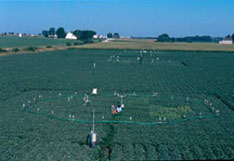
79o05’W). This facility uses FACE technology to increase the CO2
concentration in three of six experimental plots within a continuous
unmanaged Pinus taeda plantation (Hendrey et al., 1999). Each
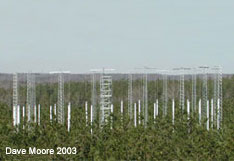
plot is 30-m in diameter and consists of a circular plenum that delivers air
to an array of 32 vertical pipes. The pipes extend from the forest floor to
above the 18-m tall forest canopy and contain adjustable ports at 50-cm
intervals that allow control of atmospheric CO2
through the entire forest volume.
CO2
enrichment occurred 80% of the time as it was switched off when air
temperature was too cold for photosynthesis to occur (below 6oC)
and when windspeeds exceeded 5 m s-1. The
average CO2
concentration (24h average) in the three fully instrumented control plots
during the 6 years of the experiment was approximately 386 μmol
mol-1 and three experimental plots were
maintained at ambient plus 196 μmol mol-1
CO2
(approximately 582 μmol mol-1
during active enrichment). Seedlings were planted in 1983 in 2.4 m x
2.4 m spacing. Since that time a number of hardwood species have
established in the understory. When fumigation began in August 1996, P.
taeda trees were ~14 m tall and comprised more than 90% of the basal
area of the stand. This analysis was restricted to the P. taeda
as this species accounts for over 85% of net primary production (NPP)
in this forest (Hamilton et al., 2002).
Tree growth. In 1996 spring-loaded
stainless steel dendrometer bands, for measuring diameter, were fitted to
the boles of trees approximately 1.4 m above ground level (Keeland and
Sharitz, 1993). Diameter was measured approximately monthly on between 31
and 34 trees in each plot (105 in the ambient plots and 104 in elevated
plots). Bands were read in the same order each month and at the same time of
day to reduce the effects of diurnal changes in diameter. The basal area
increment (cm2 month-1)
was calculated for each measurement period and normalized to a 30 day
interval. The annual growth rate of each tree, expressed as relative basal
area increment (RBAI,) was calculated as the change in basal area
divided by the initial basal area for each year (Naidu and DeLucia,
1999). Because RBAI is a measure of relative growth (cm2
cm-2 yr-1)
units will be expressed as yr-1. Trees with
negative RBAI were assumed to be dead and were excluded from further
analysis. There was no statistically significant difference in mortality in
the control and treatment plots.
To account for
potential differences in the response of different sized trees to
CO2, individuals
were grouped into 4 classes based on their basal area in 1996, with equal
numbers of trees in each class. Trees in class I had a basal area
smaller than 110 cm2 and were competitively
suppressed with most of their crowns below the canopy. Class II
included trees between 110 cm2 and 193 cm2;
these trees were mostly co-dominant with their crowns defining the canopy.
Class III (trees between 193 cm2 and
270 cm2) and class IV (larger than
270 cm2) were a mixture of co-dominant and
emergent individuals with crowns extending above the canopy. Class III
contained mostly co-dominant individuals with some emergent trees, while
more than 75% of the trees in class IV were emergent.
Modeling initiation and termination of growth.
To determine if the CO2
treatment and inter-annual variation in climate affected the timing and
duration of diameter growth in P. taeda a mathematical model was used
to estimate the start, end and duration of cambial expansion in each year.
Two independent non-linear models (Proc Nlin, SAS v. 8.02, Cary, NC) for the
start of growth and the end of growth, respectively, were fitted to the
basal area measurements of each tree for each year of the experiment (Fig.
10).
For the period before the start of growth, basal area (BA)
was defined as BA = a; and after the start of growth BA
= a + b (days) + b2
(days2), where a was the
initial basal area, b was the slope of the linear portion of the
increase in basal area and b2 is the
curvature of that increase. The start day was defined mathematically as the
intersection between these two functions (Fig. 10).
The end of growth was estimated in the same way except
the end day was the intersection between the growth curve and the final
basal area (Fig. 10). Because the stop model estimated the end of growth
asymptotically we defined the end of the growing season as the day when BA
was 90% of the annual maximum. |
| |
|
 |
|
Fig. 10. The change in basal area from
December 1997 through April 1999 for a typical loblolly pine tree. Basal
area was calculated from measurement of bole diameter (DBH). The
symbols represent measured values and the lines represent models fit to the
data. Two functions were used to describe the progression of growth from
winter into summer and autumn (left panel). In winter, BA (basal
area) = a (constant), and during summer and autumn, BA = a
+ b(day) + b2(day2);
where b is the initial growth rate of the tree and b2
is the curvature of growth late in the season. The intersection of these two
functions defined the “start day”. The progression of growth from summer
into the following winter was also described by two functions (right
panel). During summer and autumn, BA = a1’
+ b’(day) + b’2(day2)
and during the following winter, BA = a’. The intersection of
these two functions defined the ‘end day’. The ‘end day’ was then modified
to accommodate the gradual cessation of growth late in the year. |
| |
|
Net primary
production. The only two components of net primary production (NPP)
quantified every year were biomass increment (above- and below-ground
biomass) and litterfall. Our estimate of NPP does not include fine
root production, herbivory or the annual production of dissolved organic and
volatile carbon (Clark et al., 2001). These components contribute
less than 10% of NPP in this forest (Hamilton et al., 2002).
Biomass per unit ground area was
estimated at the beginning and end of each year by applying site specific
allometric regressions to the diameter of each tree (Naidu et al.,
1998), and the biomass increment was the difference in these
values. Different equations were used for dominant and suppressed trees (Naidu
et al., 1998) and evidence to date indicates that the CO2
treatment has not affected the site-specific allometric regressions (DeLucia
et al., 2002). The change in diameter of trees was calculated by
applying the treatment least square mean RBAI for each size class to
all trees in that size class in each plot.
Litterfall was collected with 12
replicate 40 x 40 cm baskets in each plot as in Finzi et al., (2002);
the basket contents were analyzed twice per month from September through
December and once per month at other times. Litterfall was expressed on a
ground-area basis by dividing the total mass of P. taeda
litterfall for each plot by the area of ground covered by the baskets.
NPP was calculated by adding the mass of litterfall and the total
biomass increment for each plot. Biomass increment, litterfall and NPP
are expressed as total dry matter per unit ground area per year (g DM m-2
y-1)
Meteorological data.
To estimate the potential influence of climate on seasonal and inter-annual
variation in tree growth and productivity, precipitation and temperature
data were compiled from measurements made at the research site (from April
1997) and from the State Climate Office of North Carolina at NC State
University (before April 1997, source station: Chapel Hill 2 W, NC,
approximately 16 km from the field site). The period of active diameter
growth for the purposes of calculating temperature and rainfall totals was
defined as 15 days before the start day until the day BA reached 90% the
annual maximum. Total precipitation was estimated by summing daily rainfall
measurements during the period of active diameter growth and the degree day
totals were calculated as the sum of daily average temperature for the same
period.
Statistical analysis.
Statistical analyses were conducted with the SAS System for Windows (SAS
v. 8.02, Cary, NC). We used a repeated measures mixed model ANOVA (Proc
Mixed) to estimate the fixed effects of CO2 treatment
(2 levels: ambient and elevated), year (7 levels: 1996 to 2002) and size
class (4 levels: I, II, III and IV) on the
start, end and duration of the growing season, initial growth rate and
annual RBAI. The block, block by treatment, block by size class and
block by treatment by size class effects were considered random and the
degrees of freedom were calculated using the Satterthwaite correction. The
subject of the repeated measure was the individual tree and the covariance
structure was modeled using an autoregressive heterogeneous
variance–covariance matrix.
The initial total basal area of each plot was included
as a covariate in the model when analyzing RBAI because it strongly
influenced RBAI and varied between experimental plots. Failure to
account for this plot to plot variation caused treatment effects to be over
estimated.
Unless otherwise stated, all data presented are least
square means estimated by restricted maximum likelihood analysis within a
mixed model. Error bars are the standard error of the difference between
least squared means of the treatment and control. Tests for the treatment
effect in each year of the experiment were based on upper tailed linear
contrasts.Tests for the treatment effect on different size classes were
based on upper tailed linear contrasts.
Litterfall was analyzed similarly using a repeated
measures mixed model ANOVA (Proc Mixed), but because litterfall is a stand
level measurement the subject of the repeated measure was the individual
plot and tree size classes were not included in the model. Both biomass
increment and NPP were analysed using the same statistical model used
for litterfall except that the covariate of initial total basal area was
omitted as it had already been accounted for in the estimation of RBAI
used to calculate biomass increment.
The relationships of annual biomass increment,
litterfall, NPP, and the percent stimulation of RBAI and
NPP, to temperature and rainfall were tested using regression analysis
(Proc Reg). Analysis of covariance (ANCOVA, Proc Mixed) was used to
determine if elevated CO2 affected the slopes of the
regressions. If there was no interaction (p > 0.25) between the treatment
and the environmental variable (rainfall or temperature) the interaction
term was removed. |
| |
References
Clark DA, Brown S, Kicklighter DW, Chambers JQ,
Thomlinson JR, Ni J (2001) Measuring net primary production in forests:
Concepts and field methods. Ecological Applications, 11,
356-370.
DeLucia EH, Hamilton JG, Naidu SL et al. (1999)
Net primary production of a forest ecosystem with experimental CO2
enrichment. Science, 284, 1177-1179.
DeLucia EH, George K, Hamilton JG (2002) Radiation-use
efficiency of a forest exposed to elevated concentrations of atmospheric
carbon dioxide. Tree Physiology 22, 1003-1010.
Finzi AC, DeLucia EH, Hamilton JG, Richter DD,
Schlesinger WH (2002) The nitrogen budget of a pine forest under free air CO2
enrichment. Oecologia, 132, 567-578.
Hamilton JG, DeLucia EH, George K, Naidu SL, Finzi AC,
Schlesinger WH (2002) Forest carbon balance under elevated CO2.
Oecologia, 131, 250-260.
Hendrey GR, Kimball BA (1994) The Face Program.
Agricultural and Forest Meteorology, 70, 3-14.
Hendrey GR, Ellsworth DS, Lewin KF, Nagy J (1999) A
free-air enrichment system for exposing tall forest vegetation to elevated
atmospheric CO2. Global Change Biology, 5,
293-309.
Keeland BD, Sharitz RR (1993) Accuracy of Tree Growth
Measurements Using Dendrometer Bands. Canadian Journal of Forest
Research-Revue Canadienne De Recherche Forestiere, 23, 2454-2457.
Naidu SL, DeLucia EH, Thomas RB (1998) Contrasting
patterns of biomass allocation in dominant and suppressed loblolly pine.
Canadian Journal of Forest Research-Revue Canadienne De Recherche Forestiere,
28, 1116-1124.
Naidu SL, DeLucia EH (1999) First-year growth response of
trees in an intact forest exposed to elevated CO2.
Global Change Biology, 5, 609-613.
Schäfer KVR, Oren R, Ellsworth DS, Lai CT, Herrick JD,
Finzi AC, Richter DD, Katul GG (2003) Exposure to an enriched CO2
atmosphere alters carbon assimilation and allocation in a pine forest
ecosystem. Global Change Biology, 9, 1378-1400. |
Created 05/27/04
Updated 05/27/04
|