Insect-plant interactions: coevolutionary arm races and alliances
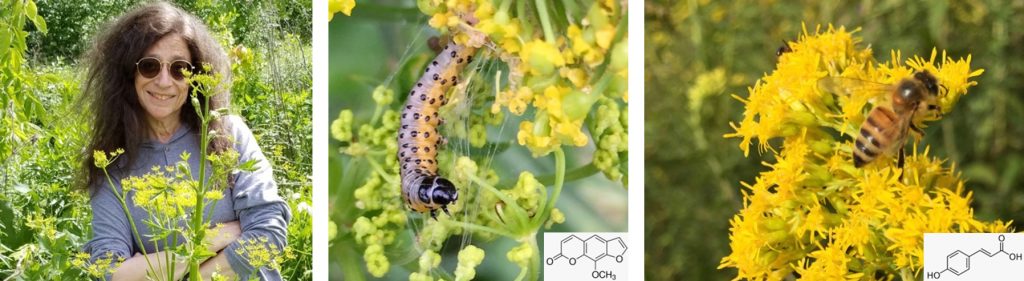
Left: May Berenbaum with wild parsnip (Pastinaca sativa); Middle: Parsnip webworm (Depressaria radiella) with wild parsnip and the linear furanocoumarin xanthotoxin; Right: Western honey bee (Apis mellifera) with goldenrod (Solidago sp.) and the phenolic acid p-coumaric acid.
Angiosperm plants and the insects that eat them represent more than a half-million species, comprising about half of eukaryotic life in terrestrial ecosystems. As befits such spectacular diversity, interactions of all kinds have arisen over the 300 million years or so that insects have pursued plant-feeding lifestyles. A recurring theme across these interactions is that they are generally mediated by phytochemicals, or plant secondary metabolites, which can function ecologically as toxins and repellents against enemies or attractants and rewards for mutualists. Antagonistic interactions between plants and insects can have ecological impacts, as when differential herbivory affects the structure of natural plant communities, as well as economic consequences, as when insect herbivores consume crop plants and reduce yields. Mutualistic interactions involving insect pollinators consuming nectar and pollen also have significant ecological and economic impacts, via facilitating plant reproduction. As well, plant-insect interactions often involve other taxa, particularly via mutualisms with the microbial world. These chemically mediated insect-plant interactions are the focus for research in the Berenbaum lab.
Understanding interactions among organisms demands multidisciplinary approaches and, in my lab, disciplines involved in our research have spanned the continuum from genetics, genomics, and molecular biology to community and landscape ecology. As well, in terms of experimental approaches, most projects incorporate both laboratory and field components, with “field sites” have ranged from central Illinois roadsides to rainforests in Madagascar.
We’ve wandered only rarely into vertebrate territory, with one exception—humans, as a species, have influenced eco-evolutionary processes involving insects on an unprecedented scale. Of the many ways humans have influenced interactions between plant-eating insects and flowering plants, we’ve focused on two–pesticide impacts on pollinators and herbivores and invasion biology (human-facilitated redistribution of insects around the planet). More broadly, the Berenbaum lab embraces research that illuminates mechanisms by which anthropogenic activities accelerate the evolution of insect-plant interactions is key to stemming or reversing insect declines and protecting the diversity that maintains the sustainability of Earth’s terrestrial communities.
Home | Publications | Research | People | In the News | Join the Lab | Contact | Old Site (Prior to 2022)